300 Kilometers Away...
Suzuka has hosted legends, settled rivalries, and built a fan culture unlike anything else in Formula 1


There is a race on the Formula 1 calendar that does not feel entirely real. Not because of what happens on track, though plenty of wild things have happened on track. But because of everything around it. The atmosphere, the culture, the fans who show up in full cosplay as their favorite drivers, complete with hand-painted helmets and homemade signs for backmarkers who retired years ago. Suzuka is the one race every year where I feel a specific kind of fomo... the kind that reminds you there are places in this world you simply need to experience before you run out of time.
In 2024 I finally made it to Japan. Tokyo, Yokohama, and The Biggest and Craziest Japanese Car Parts Store In The World. But not Suzuka. The race wasn’t on the calendar during my trip, which I knew going in, and yet I still felt the pull of the place even from 300 kilometers away.
That's what great tracks do. They don't need you to be standing at the fence. The pull seems to reach the surrounding areas by simply riding the breeze, from miles away, from years away, from a YouTube video of someone throwing a Skyline around Tsukuba at midnight.


Japan has been part of my automotive obsession education since long before I was following F1 seriously. I used to obsessively watch Best Motoring videos... those Japanese car magazine TV shows from the late ‘90s and early 2000s where they’d fling NSXs and Supras and Corollas around Tsukuba and Fuji at impossible speeds. The sound of a revving engine through cheap laptop speakers still managed to make Japan feel like the center of the automotive universe. It was how I learned about JDM culture, about the way Japan approaches cars as something closer to art than transportation. That obsession never really went away (I’m watching Initial D again as I type this, smh.). And when F1 eventually hooked me properly, it was almost inevitable that Suzuka would become the race I circled on the calendar every year.
The track itself first appeared on the F1 calendar in 1987, built on a site that doubles as a full amusement park, complete with rollercoasters and a 50-meter Ferris wheel that towers over the infield and gives you a panoramic view of the whole circuit layout. You can ride it on race weekend for about $5. That detail stops me every time I think about it. At most circuits, the experience outside the fence is an afterthought... overpriced food, corporate hospitality, a gift shop. At Suzuka they built a Ferris wheel so you could see the whole track at once, charged you less than a coffee for the privilege, and called it a day. That feels more like a philosophy than an amenity.
But Suzuka earned its legend the hard way. The very first Japanese Grand Prix in 1976 happened not at Suzuka but at Fuji Speedway, in conditions so brutal that Niki Lauda climbed out of his car after two laps and walked away from a world championship fight rather than risk his life in the rain. He had survived a near-fatal crash at the Nürburgring earlier that season and decided the title wasn’t worth dying for. James Hunt went on to win the points he needed. If you haven’t seen Rush, go watch it this weekend. That story deserves the full treatment.
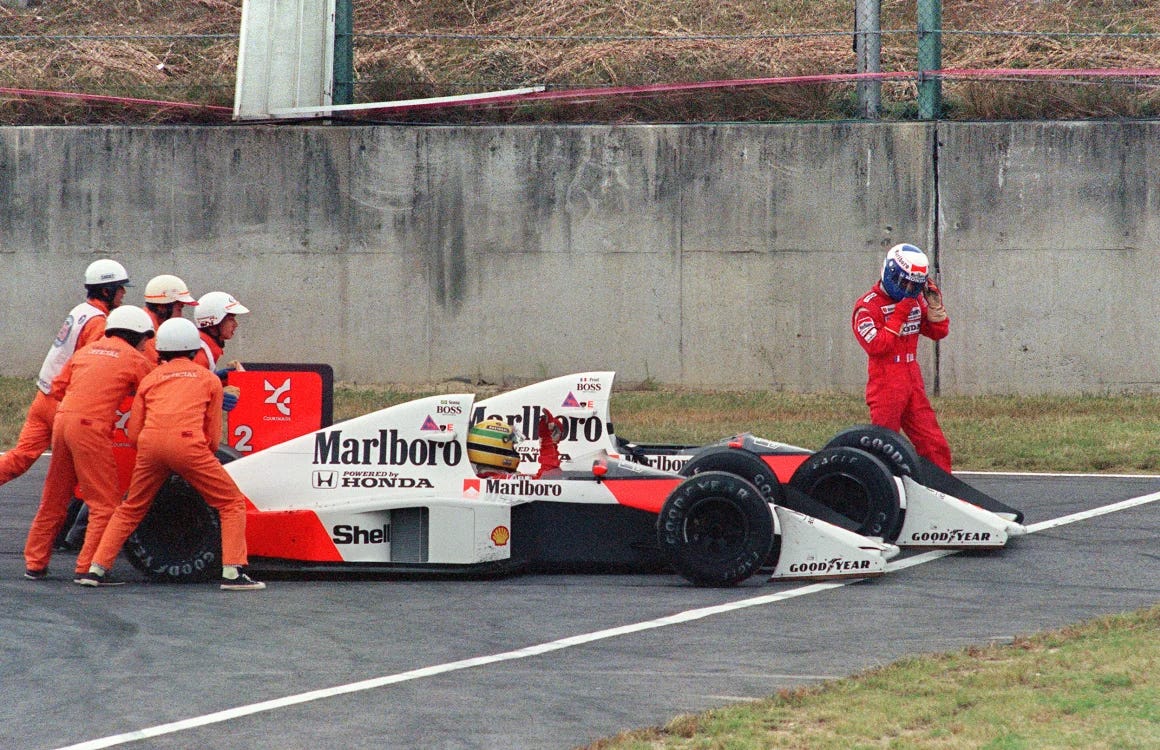
When Suzuka took over from Fuji on the calendar in 1987, it immediately started collecting legends of its own. The ones that stayed with me as a younger fan getting into the sport were Senna and Prost. For new fans to the sport, this was the Lewis versus Max battle of the ‘90s. Two years in a row, back-to-back, the world championship was decided at this track through contact between the same two drivers. In 1989, they collided at the chicane late in the race, Senna rejoined, won on the road, and was then disqualified, handing Prost the title in one of the most controversial decisions in F1 history. In 1990, Senna drove into Prost at the first corner on the first lap, both cars out instantly, championship secured. He later admitted it was deliberate. Payback. Suzuka held all of that. The politics, the rivalry, the brilliance and the ruthlessness of two of the greatest drivers who ever lived. I think about those races every time the calendar comes back around.
The fans who pack the grandstands for all of this are something else entirely. Japanese F1 fans are famously polite and also completely unhinged in the best possible way. Full cosplay is normal. Kids dressed head to toe as Lance Stroll with homemade helmets. Bento boxes and flasks of green tea in the general admission areas, picnic mats laid out on the grass like it’s a Sunday festival, which in a way it is... a festival that just happens to have the fastest cars in the world flying past at 300 kilometers per hour. There is nowhere else on the calendar that looks like this. I have watched it from a couch in California for more years than I can count, and every time the camera cuts to those grandstands I feel the same thing... not quite envy, something closer to recognition. These are my people. They just got there before me.
This past weekend was a good race to anchor all of that feeling around. Kimi Antonelli won after falling to sixth on the grid because of a poor start, recovered through the field, and then benefited from a safety car triggered by a heavy crash for Oliver Bearman at the Spoon hairpin. Back-to-back wins. Championship lead. Youngest driver ever to lead the standings at 19. The kid is the real deal.
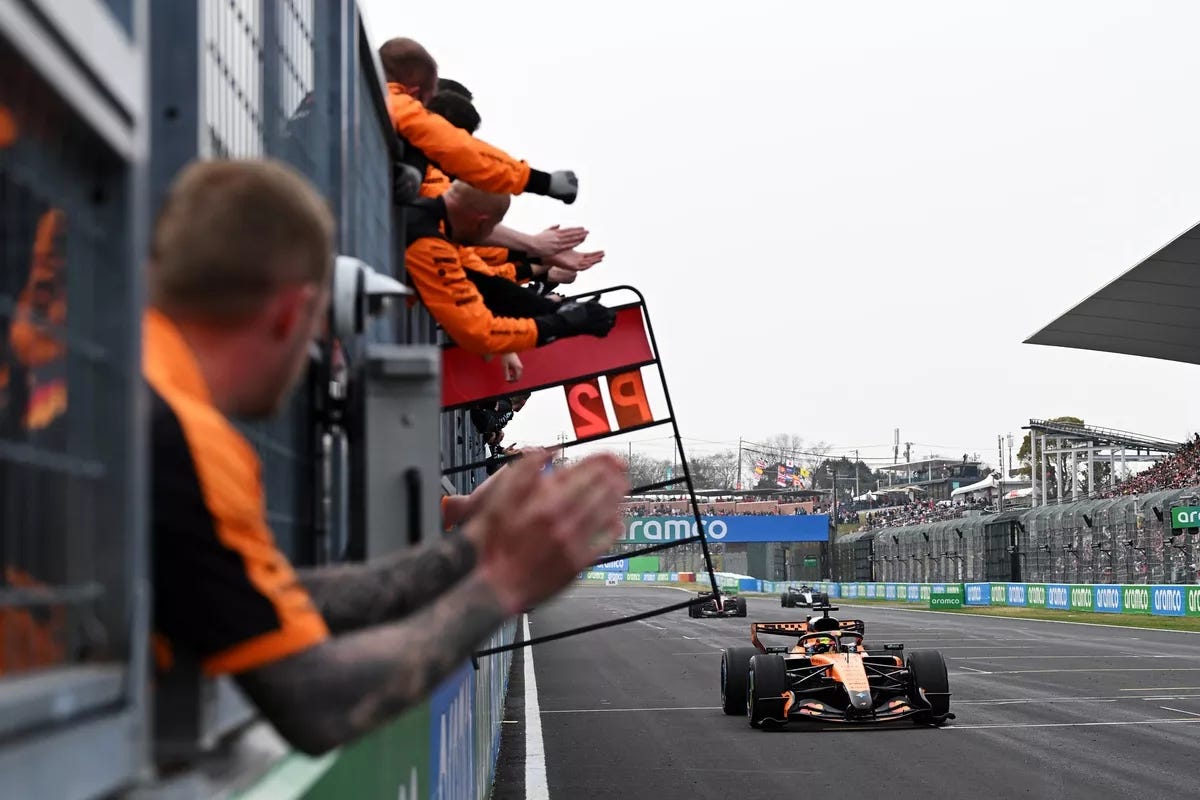
But the driver I kept watching was Oscar Piastri. He’d missed the first two rounds of the season entirely... one of those early-season situations that happens and you just have to absorb it. Suzuka was his first race start of 2026 and he led for over 20 laps, holding off George Russell and looking entirely capable of winning before the safety car reshuffled everything in Antonelli’s favor. Second place in his first race back. To me that’s the kind of quiet resilience that separates good drivers from great ones.
His radio message to the team as the race came to an end, summed up the McLaren weekend perfectly… “Wow. Turns out when we start these things we’re pretty good.”
Fernando Alonso missed qualifying because his first child was being born. He made it to the race, finished 18th and a lap down, which by Aston Martin’s 2026 standards counts as a result. There is something very Alonso about showing up to a race weekend fresh from becoming a father and still dragging that car around a circuit that has humbled better machinery than his.
Every year I watch the Japanese Grand Prix and think the same thing. One day. One day I make it to that track, buy a ticket, and sit in one of those grandstands at the S-curves while the cars howl through at speeds that make no physical sense. I'd bring something good to eat... probably egg sandwiches and onigiri I found that morning at a convenience store, because if you've been to Japan you know that a 7-Eleven there is not the same conversation as a 7-Eleven anywhere else. One day I ride the Ferris wheel and look out over Ise Bay with the whole circuit spread out below me, and I stop watching this race like someone with unfinished business.
I was 300 kilometers away in 2024. That’s closer than I’ve ever been.
If you enjoyed this issue, send it to a friend, follow along on Instagram and Bluesky, or listen to the Exhaust Notes podcast online, on Apple, Spotify, or on YouTube.
Suzuka is by far my favorite race and it’s truly the people that make it next level! Its high in my sport events bucket list 🤭